
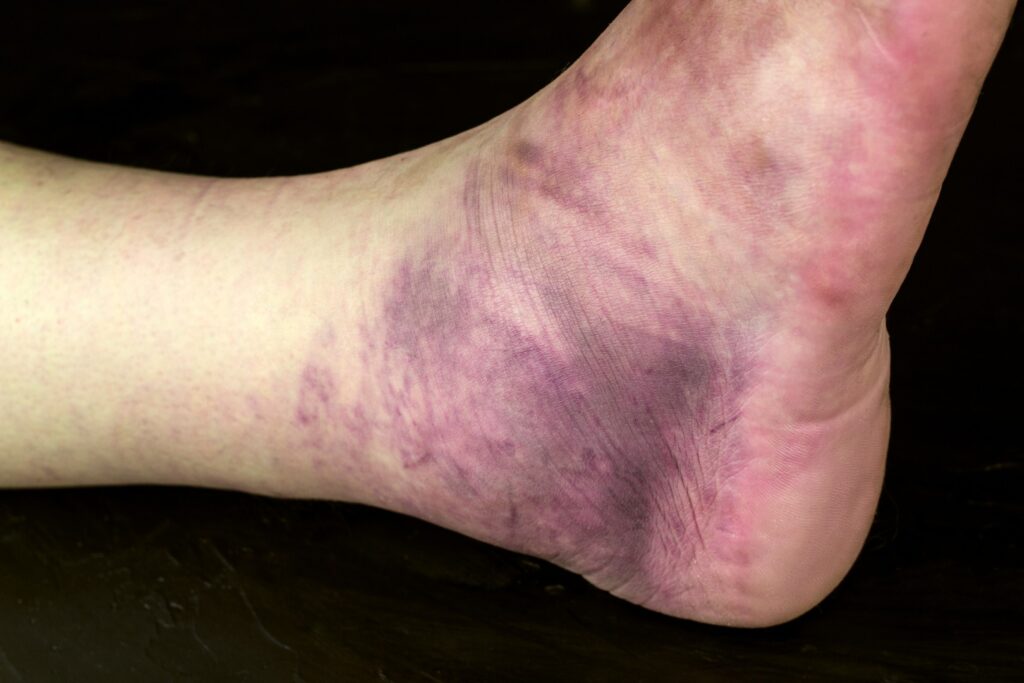
Also known as a two-part ankle fracture involving both sides of the ankle joint.
A bimalleolar fracture is a type of ankle fracture that involves two of the three bones that make up the ankle joint; the lateral malleolus (the outer part of the fibula) and the medial malleolus (the inner part of the tibia). As this injury affects both sides of the ankle, it is often unstable and therefore more likely to require surgical treatment.
They are a serious ankle fracture due to the disruption of multiple stabilising structures in the joint.
Types of Bimalleolar Fractures and Mechanism of Injury
Bimalleolar fractures involve a break to the fibula on the outside of the ankle and a break to the tibia on the inside of the ankle.
Sometimes, they are part of an even more complex pattern, like a trimalleolar fracture, in which the back of the tibia (posterior malleolus) is also involved.
The mechanism of injury for most bimalleolar fractures includes:
- Twisting or rolling the ankle during sport or while walking on uneven ground
- High-impact trauma, such as motor vehicle accidents
- Falls: These are particularly common in older adults or those with poor bone strength
The ankle is a weight-bearing joint, so any injury that disrupts both sides of the joint can lead to loss of stability and difficulty walking.
Symptoms and Diagnosis of a Bimalleolar Fracture
The common symptoms of bimalleolar fractures include:
- Severe pain at the time of injury
- Swelling and bruising around the entire ankle
- An inability to stand or walk on the affected leg
- A feeling of the ankle being unstable or “giving way”
- Visible deformity or misalignment will be seen in severe cases
Diagnosis
To confirm a diagnosis of Bimalleolar fracture, you will need an assessment from a medical provider skilled in orthopaedics.
A history of the injury will be taken, and any relevant medical history discussed.
A physical examination is required to assess tenderness, swelling, and joint stability.
X-rays (AP, lateral, and mortise views) will confirm the fracture and assess how far the bones have shifted.
In some cases, CT or MRI scans may be needed to examine joint involvement more closely, especially if surgery is being considered.
Treatment Approaches for a Bimalleolar Fracture
Treatment for a bimalleolar fracture depends on whether the joint is stable.
Surgery is commonly needed, as these fractures often lead to instability. The common surgery technique is Open Reduction and Internal Fixation (also known as ORIF). The bones are repositioned and secured with metal plates and screws.
It is important to stabilise the syndesmosis (the ligament between the tibia and fibula) if it has been damaged.
Non-surgical treatment may be an option in select cases where the bones are perfectly aligned and the ankle remains stable. This usually involves wearing a moon boot or cast and Non-weight bearing for several weeks.
Regular follow-up X-rays are needed to assess that the bones have not shifted during healing.
Prognosis for a Bimalleolar Fracture
Most bimalleolar fractures heal well with proper treatment, but the recovery takes time.
- Bone healing typically takes around 6-8 weeks
- Return to full activity may take 3-6 months, depending on the severity of the injury and whether surgery was required
- Physiotherapy may be required to help in restoring strength, balance, and range of motion
There may be some long-term stiffness, swelling, or discomfort, especially after prolonged periods on your feet; however, most patients return to walking and day-to-day activities.
In some cases, especially if the cartilage was damaged or the joint alignment was not restored, post-traumatic arthritis can develop over time.
Role of Access Ortho in Diagnosing and Treating Bimalleolar Fractures
At Access Ortho, we provide fast, expert care for fractures, sprains, and strains across our Brisbane and Ipswich clinics. Whether you’ve just injured your ankle or need ongoing care following an ED or GP visit, we can help. It is important to note that as many Bimalleolar Fractures are very severe, you will often need surgical treatment. Access Ortho can help arrange this.
Access Ortho offers:
- Rapid appointments (no referral needed)
- Referral for and review of X-rays
- Immediate fitting of moon boots or splints
- Orthopaedic assessment and surgical referral if required
- Clear recovery plans and follow-up imaging
- Guidance on rehabilitation and return-to-activity guidance
We aim to ensure your ankle heals properly, prevent long-term issues, and help you confidently get back on your feet.